
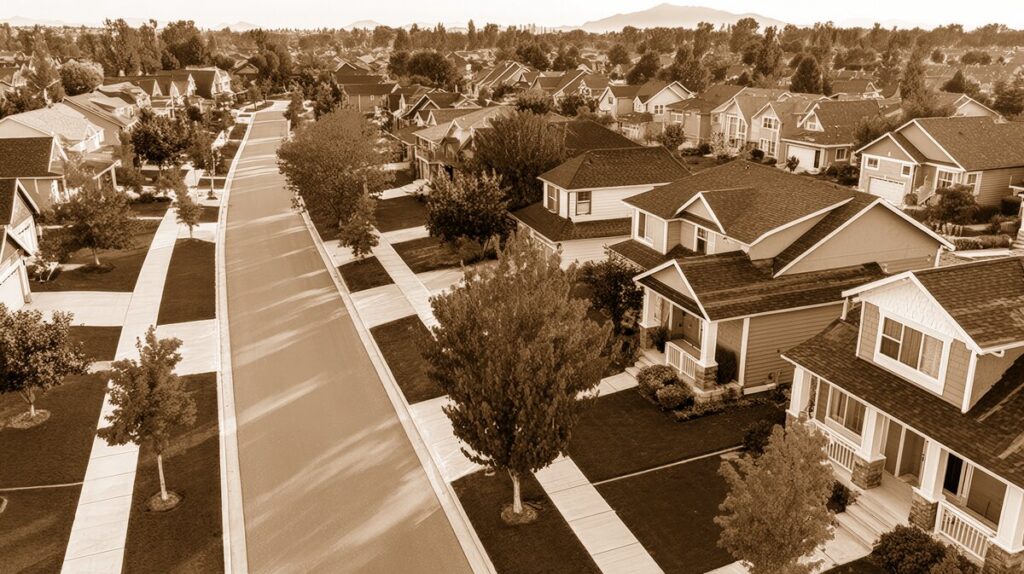
A Neighborhood with Room to Breathe
On the western edge of Arvada, where the foothills begin to feel close and the streets open toward broad skies, Sherwood Farms has a character all its own. The neighborhood is best known for its spacious homesites, mature landscaping, quiet streets, and scenic relationship to West Woods Golf Club. Addresses along West 74th Avenue, West 71st Place, Poppy Way, Orion Street, and nearby roads reflect a community designed for privacy without giving up the conveniences of modern Arvada.
Sherwood Farms is not one of Arvada’s nineteenth-century neighborhoods, nor does it have a single preserved farmhouse or commercial main street at its center. Its heritage is a more recent story: the transformation of open, semi-rural land into an upscale residential enclave during the years when west Arvada was growing rapidly. Even so, the neighborhood carries forward an older local tradition—the idea that a home should have space for gardens, trees, animals, and a view.
From Agricultural Arvada to Residential West Arvada
Arvada’s earliest history was shaped by farming. After Lewis Ralston’s 1850 gold discovery along the creek that now bears his name, many settlers who came west in search of precious metal eventually stayed to cultivate the fertile valley. By the 1860s, farms and land claims spread across the Ralston and Clear Creek valleys. Wheat, corn, oats, fruit, berries, melons, and vegetables all grew successfully in the area, and Arvada later became famous for celery production. ([arvadaco.gov](https://www.arvadaco.gov/589/The-Founding-of-Our-Community?utm_source=openai))
Sherwood Farms sits farther west and higher than Arvada’s historic downtown, but it belongs to that same broad story of agricultural land gradually giving way to suburban homes. In earlier decades, the area around present-day west Arvada included large parcels, ranches, cultivated fields, and open grassland. As roads improved and the city expanded toward the foothills, these properties became increasingly attractive for residential development.
The neighborhood’s larger lots are an important reminder of that transition. Many properties contain roughly three-quarters of an acre to more than an acre, giving Sherwood Farms a spacious appearance that distinguishes it from denser subdivisions built nearby. County property records identify parcels in the original Sherwood Farms subdivision and later filings, including Sherwood Farms 2nd Filing. ([countyoffice.org](https://www.countyoffice.org/property-record-16032-w-74th-ave-arvada-co-80007-0a1/?utm_source=openai))
How Sherwood Farms Got Its Name
The exact origin of the name “Sherwood Farms” is not well documented in readily available public histories. There is no known city landmark or pioneer named Sherwood who clearly explains the title, and the neighborhood’s name appears to have come through the subdivision and development process rather than from a formally preserved historic estate.
Still, the name fits the landscape and the ambitions of the development. “Sherwood” evokes a wooded countryside, while “farms” suggests open land and a rural past. Together, the words create an appealing image of a peaceful country setting close to town. That image remains visible today in the neighborhood’s generous lots, mature trees, winding residential streets, and occasional horse-property zoning.
In that sense, the name is less a literal record than a description of the lifestyle the community was intended to offer: a country-like setting with modern homes, room for recreation, and easy access to the rest of Arvada.
The Neighborhood Takes Shape
Available property records indicate that many Sherwood Farms homes date from the 1980s and early 1990s. One representative property in Sherwood Farms was built in 1987, while other records show later homes and additions associated with subsequent filings. ([redfin.com](https://www.redfin.com/CO/Arvada/16234-W-71st-Pl-80007/home/34349424?utm_source=openai)) This timing places the neighborhood within a major period of west Arvada growth, when formerly open areas were being planned as large-lot residential communities.
Rather than relying on one uniform architectural style, Sherwood Farms developed with a varied collection of custom and semi-custom homes. Brick, stucco, stone, wood siding, broad rooflines, porches, decks, and extensive garages appear throughout the community. The result is a neighborhood that feels established without being architecturally repetitive.
The layout also reflects its era. Streets such as Poppy Way and Orion Street serve quiet residential pockets, while West 74th Avenue and West 71st Place provide recognizable connections through the area. Many homes sit back from the road, screened by trees or landscaping. That separation, along with the large lots, gives the neighborhood an almost rural rhythm even as surrounding Arvada has filled in.
West Woods and the Open-Space Feeling
One of Sherwood Farms’ defining landmarks is West Woods Golf Club, located at 6655 Quaker Street. The city built the original 18 holes in 1994, with the Sleeping Indian and Cottonwood courses designed by Colorado golf architect Richard M. Phelps. A third nine, the Silo, was added in 1998–99. ([westwoodsgolf.com](https://www.westwoodsgolf.com/golf-course/course-overview?utm_source=openai))
For nearby residents, West Woods is more than a golf facility. Its broad fairways, native vegetation, mountain views, and open corridors help preserve the spacious feeling that attracted many homeowners to west Arvada in the first place. The course also provides a visual transition between neighborhoods, roads, and the foothills.
The surrounding landscape offers other recreational connections as well. Quaker Street, Ward Road, and the network of trails and parks in west Arvada make it possible to reach shopping, schools, golf, and open space without losing the neighborhood’s quieter atmosphere. In many ways, Sherwood Farms benefits from being close to major amenities while remaining tucked away from heavy commercial activity.
Heritage in Everyday Details
Sherwood Farms does not announce its history with plaques or restored buildings. Instead, its heritage lives in smaller details:
- The broad lots that recall Arvada’s agricultural past
- Mature trees and long-established landscaping
- Homes built during west Arvada’s suburban expansion in the 1980s and 1990s
- Views toward the Front Range and open land around West Woods
- A residential pattern that favors privacy, space, and neighborly quiet
That heritage is also part of a larger Arvada story. The city began as a farming community after the gold rush, grew through transportation and agriculture, and eventually became a suburban city connected to the Denver metropolitan area. Sherwood Farms represents one of the later chapters in that evolution—the moment when rural land was carefully adapted for residential life. ([arvadaco.gov](https://www.arvadaco.gov/589/The-Founding-of-Our-Community?utm_source=openai))
A Community That Continues to Evolve
Over the decades, Sherwood Farms has matured. Young trees have become substantial shade canopies, original homeowners have welcomed new generations, and houses have been renovated to suit changing needs. Some properties have gained updated kitchens, outdoor living spaces, expanded garages, or new landscaping, while the neighborhood’s overall character has remained remarkably consistent.
Today, Sherwood Farms feels special because it balances two qualities that do not always coexist: privacy and connection. Residents can enjoy a large-lot, semi-rural atmosphere, yet they are still close to Arvada’s schools, businesses, parks, Olde Town, and regional roadways.
For longtime residents, the appeal is easy to understand. Sherwood Farms preserves a sense of breathing room—a reminder that Arvada’s past was once measured in fields, farm lanes, and wide horizons. Its story is not only about when houses were built. It is about how a piece of the city retained the feeling of the countryside while becoming part of a growing Colorado community.